Golf Course Maintenance: A Practical Guide, Year-Round
Golf course maintenance happens in real time. The surface shifts daily, moisture moves through the soil and turf responds differently across the same hole. Some mornings everything lines up. Other days the course pushes back and forces adjustment.
Golf Course Maintenance
Every decision affects how the course plays. Mowing influences speed. Moisture changes firmness. Organic matter affects ball roll. Even small golf course maintenance practices can have a noticeable impact on the golfer’s experience.
Some maintenance activities happen every day. Others are performed regularly throughout the season. Some are only carried out once or twice a year when conditions allow. Together, they form a complete golf course maintenance programme.
Mowing
Mowing is the most frequent maintenance activity on the course. Small changes in height of cut can influence green speed, turf health and presentation. Consistency is often more important than cutting height itself. Uneven mowing quickly becomes visible to golfers and can affect playing conditions across the course.
How Often? Daily during active growth periods.

Irrigation and Moisture Management
Water management is a constant balancing act. Too little moisture creates stress. Too much moisture softens surfaces and limits oxygen movement through the soil.
Water should move through the profile rather than sit on the surface. When puddling appears, it often signals a deeper issue within the rootzone. Poor drainage, compaction and excessive organic matter can all contribute to water remaining where it is not wanted.
How Often? Daily monitoring with adjustments as conditions change
Bunker Maintenance and Presentation
Bunkers are among the most visible features on a golf course. Wind, rain and play constantly move sand, making regular maintenance essential.
Presentation extends beyond bunkers. Clean edges, tidy walkways and well-maintained surfaces all contribute to the golfer’s experience.
How Often? Daily or as required.
Grooming and Brushing
Once the basics are covered, attention turns to refinement.
Grooming and brushing help improve presentation and playing quality by standing the grass upright before mowing, removing dew which can increase disease risk and getting rid of worm casts in a way that respects regulations.
How Often?
From daily dew removal during periods of heavy moisture to periodic grooming throughout the growing season, depending on turf growth and conditions.
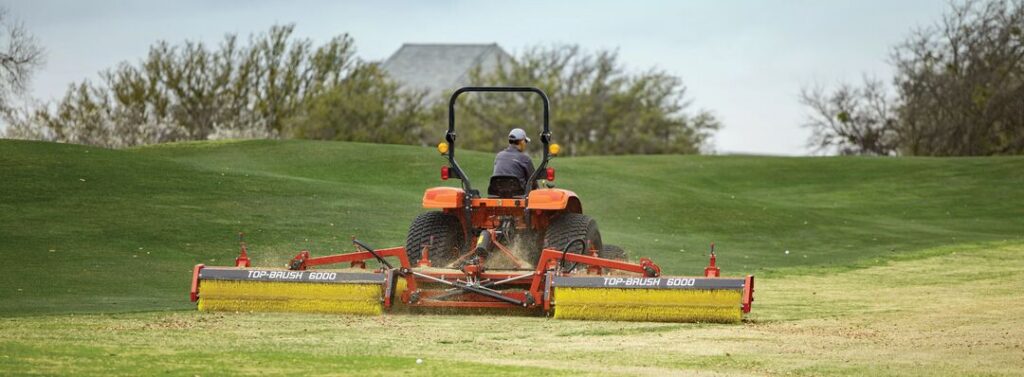
Top-Brush
The Top-Brush is designed for regular brushing and surface refinement. It helps stand the grass upright before mowing, remove dew and get rid of worm casts.
Topdressing
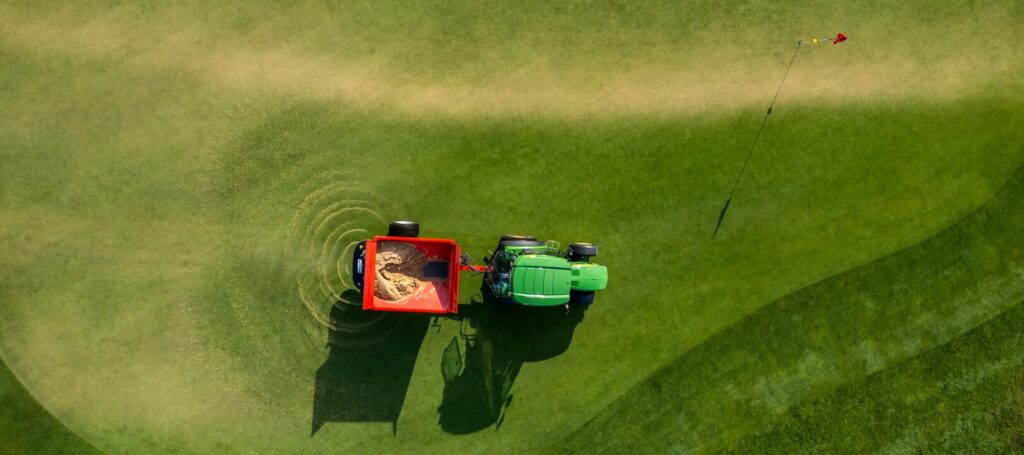
In golf course maintenance, topdressing helps maintain surface firmness, smoothness and turf density. Regular sand applications dilute organic matter, support healthy growth and help create more consistent playing conditions throughout the season. Most courses favour lighter, more frequent applications rather than occasional heavy treatments.
Actively growing turf generally requires more frequent topdressing because it produces more organic matter and can incorporate sand more quickly. When growth slows, less topdressing is often required as the turf cannot work the sand into the surface as efficiently.
How Often?
Every one to four weeks during the playing season, depending on growth and conditions.
Machines
Rink 1010
Low-weight, durable, brush-spreader for greens.
Sandstorm
Self-powered disc-spreader. No tractor needed. Just hitch and spread.
Dethatching, Verticutting, Scarifying
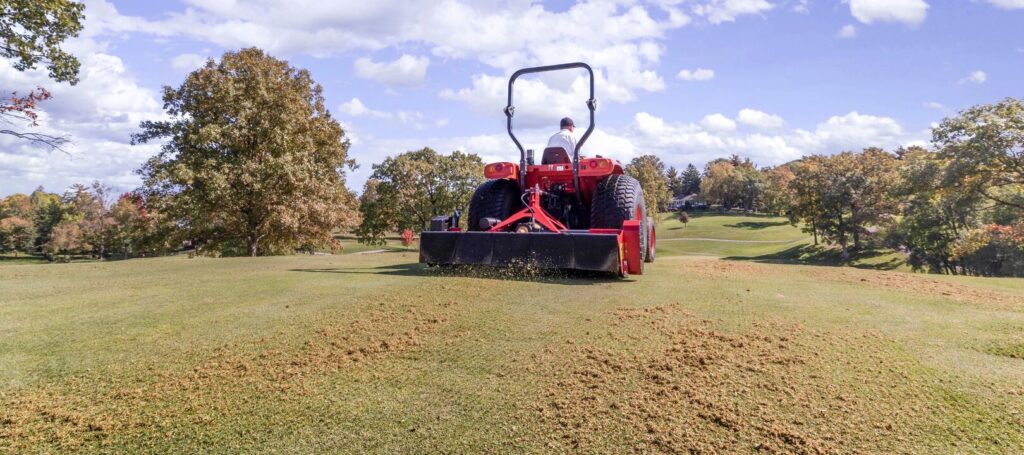
A small amount of organic matter helps cushion the surface and protect the turf. Over time, however, grass clippings, stems and other plant material begin to accumulate. Left unmanaged, this organic layer can interfere with ball roll, hold excess moisture and reduce surface quality.
In spring, different grasses often begin growing at different rates. This uneven growth can leave greens looking shaggy and play inconsistent. Golf course maintenance is about making an even, level course that can support quality play.
Dethatching is the lightest and most superficial of the three maintenance methods. Verticutting (short for vertical cutting) bridges the gap between dethatching and scarifying, but it focuses primarily on controlling growth rather than just removing waste. Scarifying is a heavy-duty, aggressive renovation process.

| Dethatching | Verticutting | Scarifying | |
|---|---|---|---|
| Intensity | Light / Maintenance | Moderate / Grooming | Heavy / Renovation |
| Blade Action | Springs flick the surface | Thin blades slice grass blades | Thick blades slice into the soil |
| Penetrates Soil? | No | Barely / Touch-contact | Yes (deep penetration)depending on area |
| Primary Goal | Pull up loose thatch & moss | Standardize growth & prevent thatch | Remove dense thatch & aerate soil surface |
| Best Frequency | Once or twice a year | Every few weeks (in growing season) | Once every 1–3 years (autumn) |
How Often?
- Dethatching: Once or twice a year
- Verticutting: Every few weeks (in growing season)
- Scarifying: Once every 1–3 years (autumn)
Machines
Verti-Cut
Precision verticutting and dethatching for controlling organic matter and improving surface quality.
Turf-Tidy
Cut and collect: verticut, dethatch and vacuum it up in one pass.
Aeration
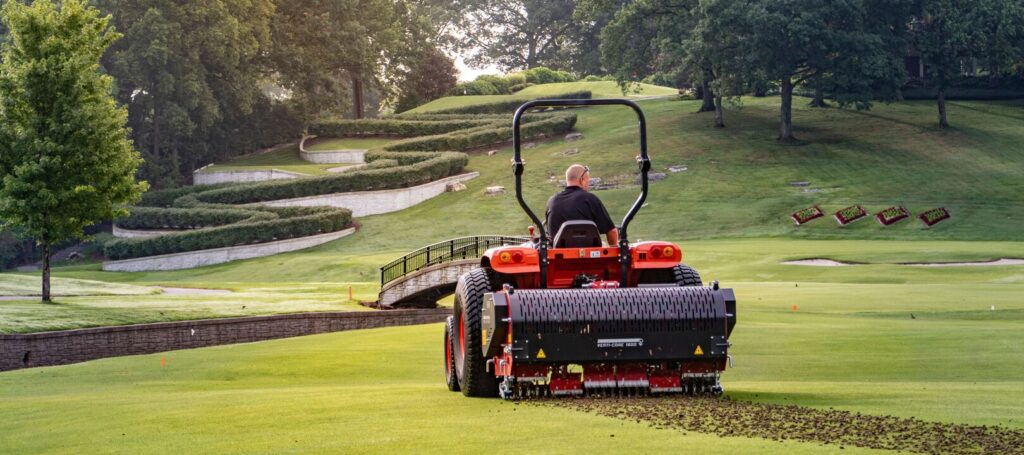
Compaction develops gradually through traffic, weather and maintenance equipment. Left untreated, it restricts the movement of air, water and nutrients through the profile.
Aeration relieves this pressure and creates pathways for air, water and root growth. While many golfers associate aeration with a single maintenance week, ‘a golf course maintenance break’, modern courses typically use a combination of lighter treatments and larger maintenance operations throughout the season. Modern golf course maintenance is an ongoing process rather than a series of isolated events.
(source; GCSAA)
Greens Aeration
Greens require a different aeration strategy than the rest of the course. Surface quality, ball roll and recovery times all need to be considered.
Most greens aeration uses solid, micro or needle tines to maintain air exchange, drainage and root health while minimising disruption to play. Hollow coring is typically reserved for larger maintenance programmes where organic matter removal is also required.
Verti-Drain 1513
The Verti-Drain 1513 treats greens and tees right without ripping up the turf. It becomes walkable with the Redexim Carrier for the ultimate aerator for greens.
Verti-Drain 1517
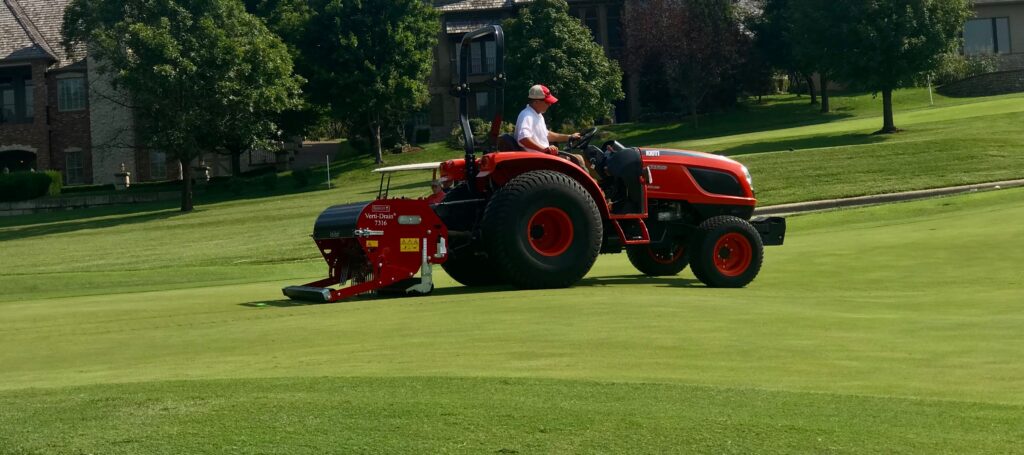
The Verti-Drain 1517 is wider than many tractors found in the field, saving you from repeated work. You can work cool and comfortable from your seat in the cab. And on greens, customers report, aerating 3.5 acres in 8 hours including cores pick up and turning in real conditions.
Fairway Aeration
Maintaining healthy greens is one challenge. Relieving compaction across fairways, approaches and other high-traffic areas is another.
Depending on conditions, managers may choose solid tines for compaction relief or hollow tines where organic matter removal is also required. Some courses also have to work around stony ground, buried rubble and remnants of past construction hidden beneath the surface.
Verti-Drain 2519
When large areas need attention in a short maintenance window, productivity matters. The Verti-Drain 2519 combines deep aeration with the working width needed to cover significant large areas efficiently.
Verti-Drain 7215
The Verti-Drain 7215 brings proven deep-tine aeration to courses operating smaller tractors. It offers a practical balance of depth, manoeuvrability and operating cost.
Verti-Quake 2516
Not every fairway sits on soft, easy soil. The Verti-Quake 2516 is designed for sites where stones, debris and difficult ground conditions are part of the job. Its linear aeration action creates drainage channels while continuing to work where conventional tine aerators may struggle.
Choosing Aeration Equipment for Your Needs
When selecting golf course aeration equipment start with your conditions and needs. For example, if greens begin to hold water after light irrigation, the surface has sealed. Aeration moves up the schedule. From there, the choice comes down to surface sensitivity, area to cover and time available. Which machine can do that in time and in budget? Here, we show common problems and the machines that are the solution.
| Condition | Equipment | Min HP |
|---|---|---|
| Greens flooding fast | Verti-Drain 1513 | 25 |
| Greens too hot for walking aeration | Verti-Drain 1517 | 28 |
| Rocky or debris filled soil | Verti-Quake | 30 |
| Greens to fairway. One machine. | Verti-Drain 7316 | 35 |
| Aerate during active play | Level-Spike | 35 |
| Hollow coring in short window | Verti-Core | 45 |
| Renovations, tough soil | Verti-Drain 7521 | 55 |
| Whole course. Limited time | Verti-Drain 2519 | 60 |
FAQs About Golf Course Maintenance
How often should golf course aeration take place?
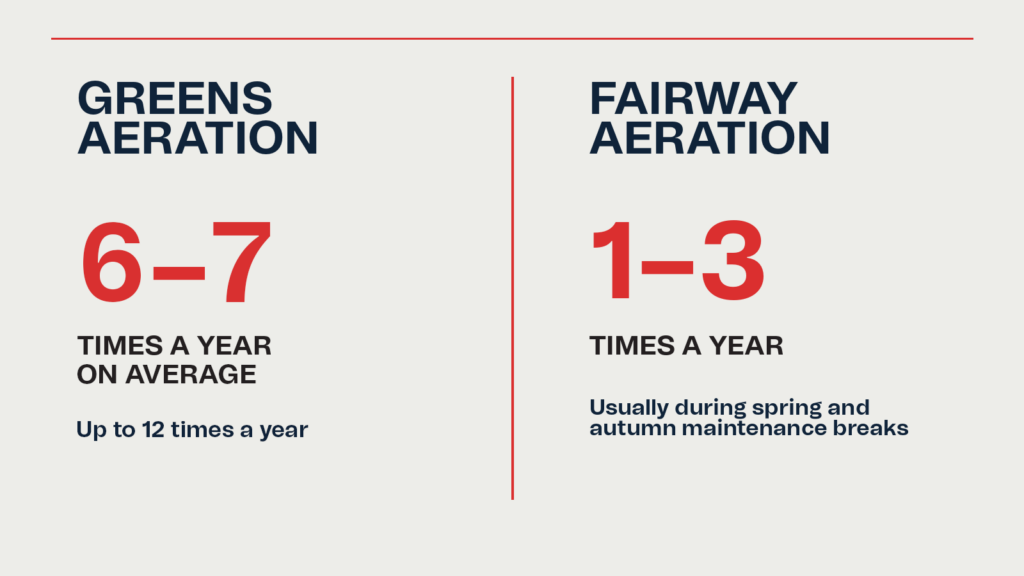
Greens aeration tends to take place six to seven times a year, but it can range from one to twelve depending on course needs and work capacity. This is because micro‑tining on greens often does not require play to stop. Fairway aeration, or programmes that cover the full course, take place one to three times a year, usually during spring and autumn maintenance windows.
Why do greens sometimes hold water after irrigation?
When water sits on the surface, it often points to compaction or a sealed profile. Air and water can no longer move freely, so the surface becomes soft and slow. Aeration restores that movement and brings the profile back into balance. It’s in Verti-Drain’s name. It’s meant to drain turf.
What do you mean ‘too hot for walking aeration’?
These days, it’s common to use walking aerators on greens, like the Verti-Drain 1513 with the Redexim Carrier. But in hot climates and on long summer days, staying cool in a tractor can be more comfortable and more efficient. In these instances, the Verti-Drain 1517 is a sensible choice that still is delicate and light enough to aerate greens correctly.
What is the difference between verticutting and dethatching?
Verticutting works near the surface, removing lateral growth and keeping the profile clean and firm. Dethatching goes deeper, removing heavier organic build-up, thatch. Both support surface quality, but they operate at different depths and intensities.
How does mowing affect playability?
Mowing directly controls speed, smoothness and consistency. Lower heights increase speed but also increase stress on the plant. Frequency and direction matter just as much, helping control grain and maintain an even surface.
How do you maintain consistency across different areas of the course?
Each area requires a different approach. Greens demand precision, fairways require balance and rough is managed for structure and play. Consistency comes from adjusting practices to each surface while keeping overall conditions aligned.
Interested in Golf Course Maintenance Equipment?
Get a quote. Answer questions.
Conclusion
Golf course maintenance relies on consistent, practical work carried out under changing conditions. Mowing defines the surface, grooming refines it and aeration keeps it functioning below ground.
With tools from Redexim, including Top-Brush, Verti-Cut and Verti-Drain, conditions improve even when resources remain limited. Over time, those decisions shape the course in ways every player experiences.