Tractor dethatcher: tractor-mounted dethatching for sports fields and golf turf
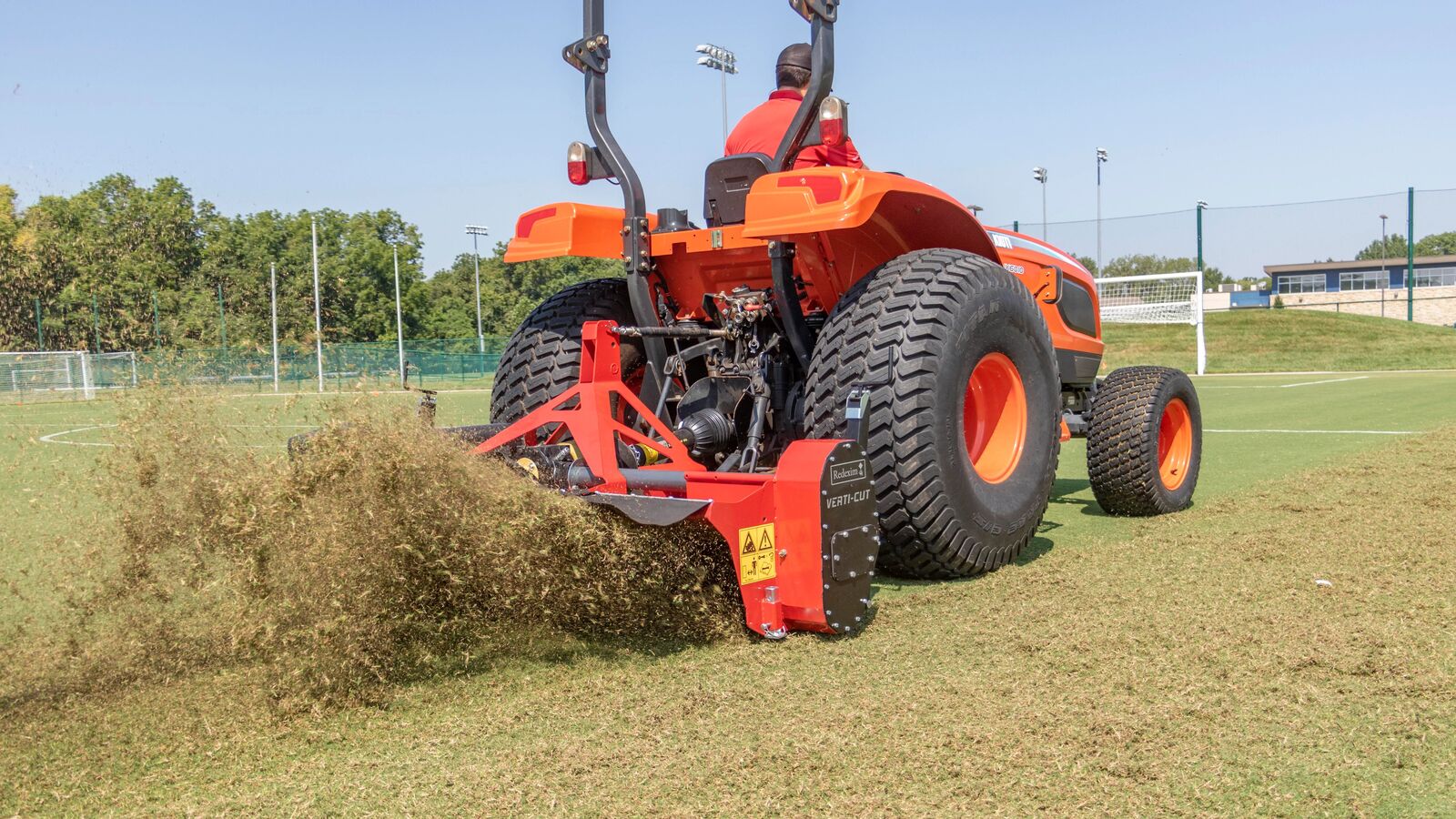
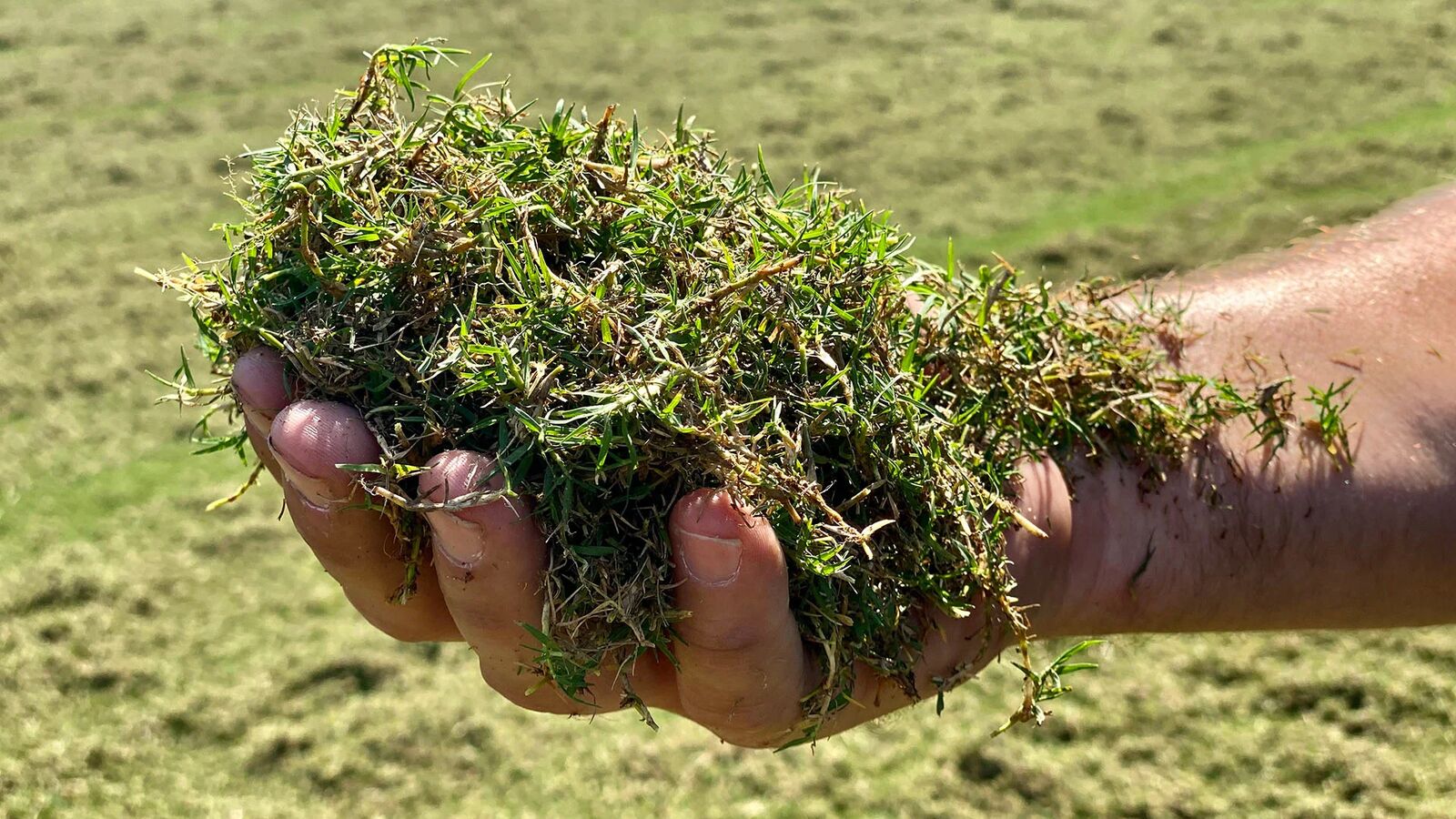
A field that feels spongy underfoot, stays wet after rain and keeps getting disease usually has a thatch problem. The layer of dead stems, roots and runners between the grass and the soil has grown too thick. Mowing does not remove it. A tractor dethatcher does: vertical blades cut into the layer and pull it out, so air, water and nutrients reach the roots again.
This page explains how a tractor dethatcher works, which type fits which job and how to choose the right width for your tractor.
What thatch does to a field
A thin layer of thatch is normal and even cushions the surface. As the USGA explains in The Trouble with Thatch, some thatch is needed for a resilient surface, but too much causes problems with playability and turf health. Problems start when thatch builds up faster than it breaks down:
- Water stays in the thatch instead of draining into the soil
- Roots grow into the thatch instead of down into the soil, so the turf dries out faster in summer
- Disease and pests find a home in the damp layer
- The surface plays soft and uneven. Mowers scalp more easily
Grasses that spread with runners above or below ground build thatch fastest. Heavy fertilizing and frequent irrigation speed it up.
Dethatching, verticutting, scarifying, fraise mowing: what is the difference?
The words overlap. In practice there are three levels of intensity:
| Method | What it does | When it fits |
|---|---|---|
| Light verticutting | Thin vertical cuts that remove some thatch and lateral growth | Routine work during the growing season |
| Dethatching / scarifying | Deeper cuts that pull out a large share of the thatch layer | Once or twice a year when thatch has built up |
| Fraise mowing | Strips the surface off completely: thatch, weeds and top layer | Full renovation of a sports field, with a fraise mower such as the Turf-Stripper. This goes beyond dethatching |
A tractor dethatcher is also called a verticutter: it mounts on the 3-point hitch and runs off the tractor’s PTO. “Vertislicer” is another name for the same machine. “Scarifier” is the UK word.
Which tractor dethatcher for which job
The choice comes down to the size of the machine, what ground it works on and whether the thatch has to be collected in the same pass.
| Type | Machine | Size | Choose it for |
|---|---|---|---|
| Tractor dethatcher | Verti-Cut® 1300, 1600, 2000 | Working width 1.3 m (51″), 1.6 m (63″) or 2 m (79″) | Flat sports fields and fairways. Pick the width that suits your area and your tractor |
| Tractor dethatcher with floating cutting wings | Verti‑Cut® Flex 2000 | Working width 2 m (79″) | Undulating ground, mounds and slopes |
| Dethatch and collect | Turf-Tidy 1100, 3000, 5000 | Hopper 1,100 L (1.4 yd³), 3,000 L (3.9 yd³) or 5,000 L (6.5 yd³) | When the thatch has to come off the surface in the same pass, without a separate sweeper. Pick the hopper size that suits your area |
| Fraise mower (renovation) | Turf-Stripper 1200, 1600, 2000 | Working width 1.2 m (47″), 1.6 m (63″) or 2 m (79″) | Beyond dethatching: a full renovation that removes thatch, weeds and the top layer |
Verti-Cut®: one machine, three widths
The Verti-Cut® is a tractor-mounted dethatcher: carbide-tipped blades cut into the thatch at an infinitely adjustable depth. The Verti-Cut® 1300 works up to 40 mm and suits compact tractors and the Redexim Carrier. The Verti-Cut® 1600 and Verti-Cut® 2000 work up to 50 mm. Choose the width that fits your area and your tractor.

Verti-Cut® Flex: for undulating ground
A fixed head bridges dips and digs into bumps. The Verti-Cut® Flex 2000 has three floating cutting wings on Passive Pivoting Suspension™ that follow every contour, so mounds and slopes are dethatched evenly without scalping. It works up to 40 mm deep.

Dethatch and collect in one pass (Turf-Tidy)
Verticutting leaves the thatch on the surface. The Turf-Tidy can dethatch, verticut, sweep or flail mow. It collects the material in its hopper in the same pass. No second pass with a sweeper is needed. Models range from the compact Turf-Tidy 1100 to the Turf-Tidy 5000 for large areas.

How to choose the right tractor dethatcher
Your tractor. Check PTO power and lift capacity. Deeper work and wider machines need more power. The Verti-Cut® 1300 suits compact tractors. The Verti-Cut® 1600 and Verti-Cut® 2000 need more power. A narrower model on a smaller tractor often gives a better result than a wide one that struggles.
Your surface. Flat sports fields suit a fixed-head Verti-Cut®. Mounded golf surrounds and undulating fairways suit the Verti-Cut® Flex 2000, whose floating cutting wings follow the contours.
What happens to the debris. A tractor dethatcher leaves the thatch on the surface. Sweep it up afterwards or blow it off with a Verti-Air® blower. If you have no time for a second pass, choose a Turf-Tidy: it dethatches and collects in the same pass.
How much thatch. Routine verticutting or a once-a-year deep clean? That decides working depth and model. More on the technique in our article on scarification machines for dethatching.
When to dethatch
Dethatch when the grass is growing actively and has time to recover. For cool-season grasses that is usually spring or early fall; for warm-season grasses late spring to early summer. Avoid very wet or very dry soil. Overseeding straight after dethatching uses the open surface to get seed into the soil.
Conclusion
A tractor dethatcher, also called a verticutter, removes the thatch layer that makes a field soft, wet and prone to disease. Choose the method by how much thatch you need to remove and the model by your tractor and your ground: the Verti-Cut® for flat fields, the Verti-Cut® Flex for undulating turf or the Turf-Tidy to dethatch and collect in one pass.
Not sure what your surface needs?
Tell us about your surface and the problems you see. A Redexim specialist will advise you on the right approach and the machines that fit.
Frequently asked questions
Is a verticutter the same as a dethatcher?
Largely, yes. Both cut vertically into the turf. “Verticutting” usually means lighter, more frequent work; “dethatching” a deeper pass to remove built-up thatch.
How deep should a tractor dethatcher cut?
Just through the thatch layer into the top of the soil. The Verti-Cut® works up to 40 or 50 mm depending on the model, adjustable to the job.
What size tractor do I need for a tractor dethatcher?
That depends on the model and the working depth. A specialist can match a Verti-Cut® to your tractor’s PTO power and lift capacity.
Should I collect the thatch after dethatching?
On fine turf and sports fields, yes. Collect it with a sweeper or use a cut-and-collect machine such as the Turf-Tidy.
What does a tractor dethatcher cost?
That depends on the model, the options and your region. A Redexim specialist can advise you; quotes come through your local Redexim dealer.